Showing posts with label Rothko. Show all posts

Wednesday, 14 May 2014

Thoughts on Rothko's restored painting and creative channelling


Study for painting, The Departed series


The above link takes you to the Tate short film about the restoration of the Rothko painting, one of the paintings from the Seagram Murals series, which was damaged with graphiti ink over a year ago.

I have books on Abstract Expressionism in my personal library and a couple on Rothko.  It is a long time since I have been able to look at them because they have been in strorage for most of the time since I moved up to N Yorks nearly nine years ago.  They have only just recently been unpacked and placed reverently on a shelf.  I have not looked at any Rothko paintings, whether in reproduction in my books, or at Tate for a very long time.

It was, therefor quite an experience to watch this video and to be reminded of the beauty, presence and majesty of the works.  I was also quite taken aback; I realised during the film, that quite innocently and unintentionally, my recent drawings and paintings have reflected and connected with the obelisk shapes that Rothko used. Now, I am not so stupid as to suppose that all art can possibly be completely original, and these connections between artists works happens a lot.  What took me by surprise is the fact that I had been unaware of my connection/reflection of the Rothko motif.  In my whirring mind as I continued to watch the film, I realised that this was probably subliminal, that because of such a long lay off caused by ill health when I moved here, I was not engaging much in art or art history but that my subconcsious was probably playing a part in the making of my recent works.  

I should add here that the recent works of which I speak are not pastiches of Rothko; they are quite different; it is the connection to them that I have been reminded of that has taken me aback. The connection in some way pleases me even as it worries me in the sense that now that I am aware of it, I need to beware of allowing my work to veer too near towards Rothko's motif or characteristics.  I am not flattering myself here; just writing my thoughts down honestly as I discuss and try to make sense of what I have just experienced during the watching of the above video mere minutes ago.  (My good friend Matt Lyon, who is a very successful graphic artist just told me on facebook that we cannot escape creative channelling!)

Rothko's great works communicate so profoundly because of the humanity they reflect back at us, I think. His works deal with the great and timeless subject of our own mortality, the human condition. When I first began my recent series of work, which I am still developing, at the very end of 2012, I was thinking about my own mortality having had to confront it during my illness, as well as the then recent deaths of four of my best friends. So the passage of time, the human condition and ideas of memory and loss began to emerge as the theme of my work; the obelisks within my initial drawings represented the people I had so recently lost.  It is not so surprising that I should find that I have a connection with other artists given that this is probably the greatest theme in all the arts there is!

What has surprised me so much is that I had been unaware of the connection and this is a timely reminder that I need to be making use of my library of books again and reflecting and noting down my thoughts in visual form as I do so. Also that a visit to Tate to see the Seagram Murals, to sit and contemplate things in front of these great paintings is way overdue.


Drawing, The Departed 1V, Graphite on paper


Sunday, 17 March 2013

Does Size Matter?


Not much more to do. . . .


Reflecting on work for the week ahead, namely finishing off "History Painting"  and making a new large canvas, which will be about 5 1/2 by 7 1/2 feet, I find myself wondering why I make life so difficult for myself by making such large paintings.

It is not so much that it is difficult actually making large paintings; all paintings present the same formal problems, the most important ones for me at the moment being colour, gesture, mark making, structure and surface quality.  Large paintings simply scale up the sizes of the brushes or tools, the marks, the areas of colour and size of shapes placed within the picture plane as well as the quantities of media involved.  No, what causes me aggravation is the actual physical problem of stretching the canvases and transporting them.


This book is enormously important to me: my parents bought it through a book club membership when I was very young and I used to pour over it most days after school.  When I was doing my foundation course, my peers were always amazed at my knowledge of art and artists; it all came from this book!  My sister Rachel bought me this copy, knowing what it means to me!

So why do I constantly find myself making large work?  Ever since I was a young girl, looking through "Art Treasures of the World: An illustrated history in colour", (Paul Hamlyn, 1964) most days after school, I was drawn to the reproductions of large paintings within its pages.  It is not that I don't admire smaller work or enjoy making smaller pieces; I do.  I can be just as absorbed making work that is very small as I am by making large stuff; larger does not mean better.  


Pousin, The rape of the Sabine women, was it the word "rape" that engrossed me then, or the rhythms within the work?  I later became totally enthralled by Pollock's paintings with their amazing colour and movement.


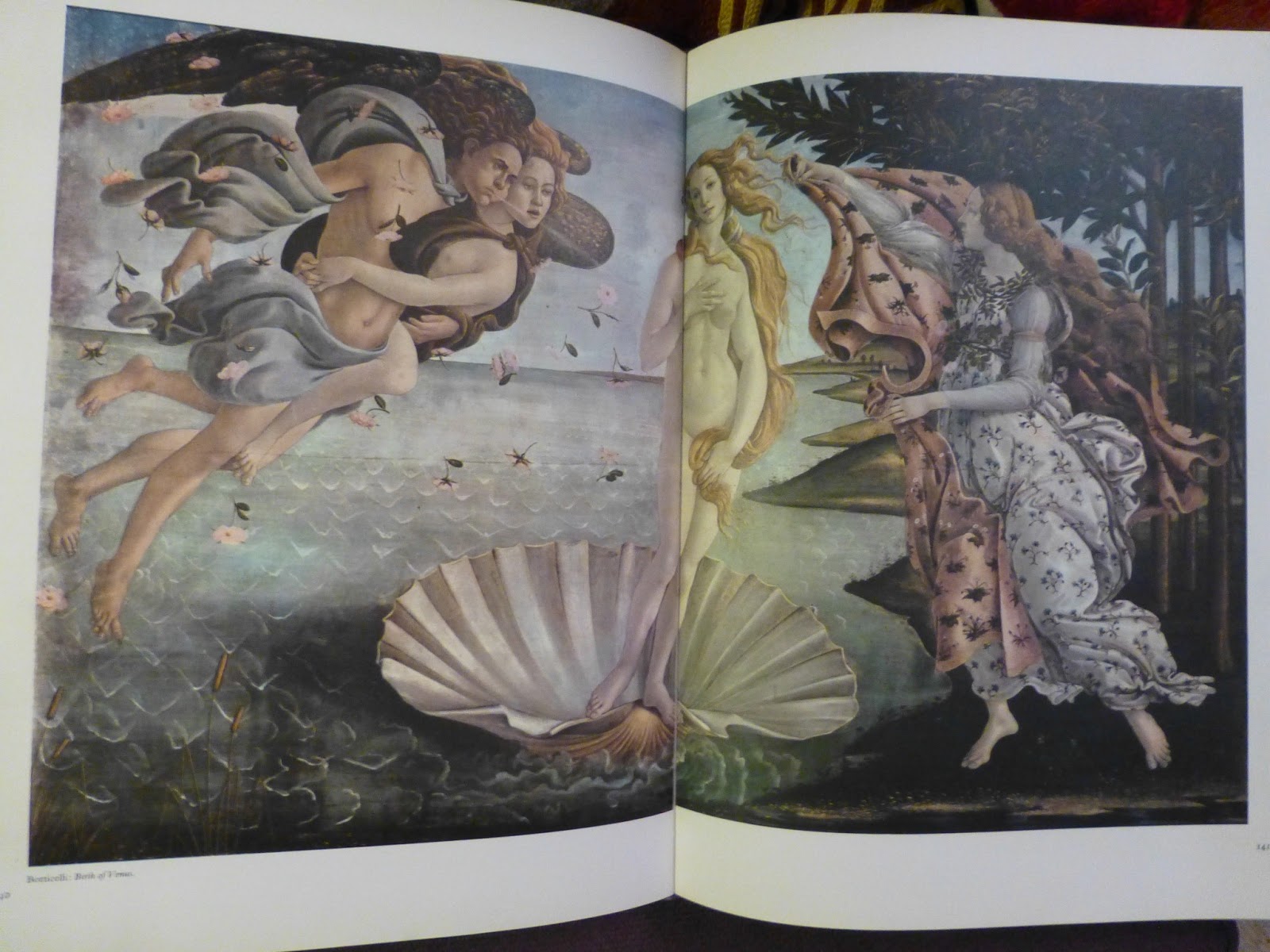
So artists have made very large works for centuries.  Botticelli, Birth of Venus.  I am lucky to have been to Florence twice so far, and I have visited this amazing painting each time.


Picasso, Night fishing at Antibes.  I have not seen this work but it looks very large!  I am longing to get to see Guernica in the not too distant future. . . .


A small, beautifully executed art work can have amazing presence and power of communication.   I have been transfixed when standing before all sorts of small works by artists ranging from the Old Masters to Modernist and Contemporary ones.   Turner's small water colours of Petworth House stupify me with their masterful handling of colour and depiction of light.   Constable's small sketches of clouds and landscapes are marvellous but the majesty of his enormous sketches in preparation for the finished works that I saw in the show, "Constable", at Tate in 1991, is awesome.  These examples are some that come immediately to mind, there are hundreds of others I could name with a little more thought and research.

There is something about standing before a painting that dwarfs me, that I can feel enveloped by, that gives me immense satisfaction.  Is it because the marks or gestures have to be scaled up in a larger painting, making evidence of the artist's physical presence more obvious so that  I feel the artist communicating with me directly?  Could be.  Is it the wonder of discerning a painting from afar and then, when up close to it, becoming lost in the wonder of brush marks, colour juxtapositions that make little sense so close, but give continuous delight, then walking slowly backwards, still looking at the painting and seeing it all come into "focus" again and make pictorial sense?  Yes!  
And is it that I am totally in love with painting?  Yes!

Rothko, Delacroix, Rembrandt, Pollock, Twombly, Michelangelo  Picasso, Monet, Braque;  some of many artists who have made very large paintings that I love to get lost in.


And have I answered my own question, why do I make large work, and does size matter?  Sort of. . . .

But: I think my next show might be called Small Is Beautiful.  'Nuff' said!


NB:  All illustrations of and from "Art Treasures of the World" are being used to illustrate this blog and are not intended for any commercial purposes.