Showing posts with label Tate Britain. Show all posts

Sunday, 23 February 2014

Brief catch up:

I am very busy as usual but somehow do not seem to be achieving very much of my own work at the moment. However, even when I was at college, I used to have months of inertia where I just seemed to freeze followed by weeks of manic production.  I wish I could keep everything on an even keel, but it just seems to be how I am.

At the end of last month I went down to London and saw the following exhibitions:

Apart from Painting Now, all these shows were truly excellent.  Klee, with 17 rooms of exhibits, was superb but exhausting.  My usual approach with exhibitions is to go through the whole show and to go back through it once I've reached the end, to revisit particularly interesting works but not for this show!  Use the links to find out more, because, frankly; I am just too lazy to write about these exhibitions.  

I will say though, that I found Painting Now to be one of the most sterile shows on painting I have ever seen.  I have since read most of the very positive reviews and the writers are all either suffering from the Emperor's New Clothes syndrome or I am completely and utterly ignorant about painting and what is going on today, which is entirely possible.  This thought frightens me somewhat and makes me feel VERY inadequate. . .

What, for heaven's sake, is the point in making paintings that aim to deny the many qualities that paint has to offer?  Even the painterly and slightly skewed urban landscapes by Simon Ling just reminded me of Ladybird book illustrations from the 50's and did not seem to be saying anything in particular; all towns and cities have their run down, derelict areas after all. Much is made of the fact that he paints them directly in front of the subject, even if they are finished in the studio, big deal!   My  opinion is that these artists would be better off writing about their subject rather than painting because the paintings did not invite me in to look for longer than a second or two and I actually found the whole experience frustrating.   I want paintings to try and engage with the quality of paint itself and what it can do, to have a bit of gesture, certainly to contain colours; the flat monotone of some of these works and the dirty colour of others, thinly applied with hardly any evidence of the hand of their maker just left me cold.  

This article popped up on my facebook feed while I was writing this blog:


It makes some very pertinent points with which I agree.  If art schools were teaching people the skills they are asking to be taught like painting, the new independent schools that are beginning to spring up such as the one led by Turps Banana Magazine would not be necessary.


Sheila Ceccarelli of Access Art emailed me on 10th February to tell me that she and Paula Briggs had attended a conference at Tate Britain the previous week where they made a presentation about collaboration in the digital age.  As part of this presentation, they used a slide of a piece of my work alongside work made in response to it by teenagers in a workshop. (Workshop not run by me).  


Does this mean I can say I have shown at Tate Britain?  HAH HAH!  


I bought a piece of thin mdf this weekend to use as a printing bed for my wooden mangle.  The mdf needs cutting down to the correct width and then I will be starting work on some prints and artists books very shortly. . .   I seem to have been saying this for a while, sigh.  But I will be doing it soon!

My studio has become slightly congested at the moment because I am storing easels and Directories for Ryedale ArtWorks and other sundry items , alongside some timber I have been saving to use on shelving projects among other things.  This is making the construction of my large stretchers for the two remaining paintings I want to make impossible and so I need to sort out somewhere for all RAW stuff to be stored for the future and quick.

We have started work on the latest Ryedale ArtWorks directory; the usual flurry of admin to keep track of who has applied, paid, reciepts sent etc has ensued.  Andy Dalton and I have managed to produce a passable document for the next Creative Commissioning bid to Ryedale District Council, so now we have our fingers crossed, while we continue delivering the projects funded from the last successful bid.

The transportation of my large painting for w0budong in Manchester on 12th March is now sorted, which is a relief.  I will be taking some trestles a table top and some chairs in the van along with the painting itself.  Oh, and 4 breeze blocks painted white, to put the painting on! I am now pondering how I will be able to anchor them to stop them moving about in the van and damaging the painting.  I might have to put them in the foot well of the passenger seat!


So as you read this, you can see I am busy.  I just need to produce some work now!


Saturday, 23 February 2013

London: Gallery Marathon Part 3


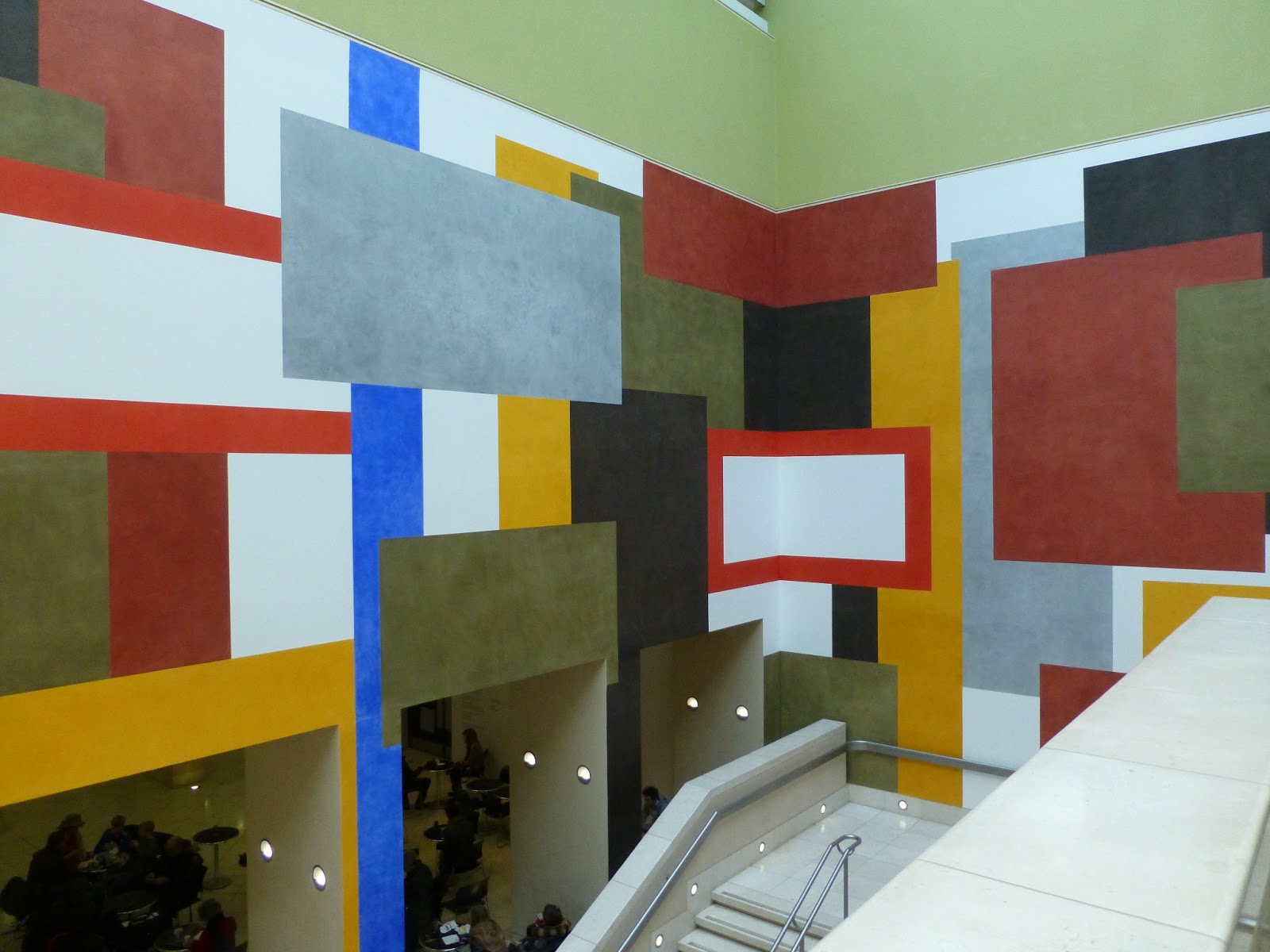
Am really liking the new extension at Tate Britain


Our entry for the Schwitters at Tate Britain was booked for 12.30, so we didn't have to rush in the morning; just as well after the previous day's work.

I remember using a postcard of a Schwitters collage as a starting point for a ceramics module during my foundation course at Basingstoke College of Technology.  What interested me about the piece was the movement and direction within it and the tonal qualities across the surface.  The colours of his collage and paint pieces must also have influenced me as, if I remember correctly, some of my early struggles with paint used similar colours as some of Schwitters abstract works although he wasn't the only influence on my work.   I must try and find some of the old stuff i did now it is all out of storage to confirm this memory, or maybe it is just wishful thinking . . . I'll see if I still have the pieces I am thinking of and take some photos to upload for later on.

 Having been classed among the "degenerates" by Hitler Schwitters fled to Norway to avoid persecution.  He was interned on the Isle of Man having fled Norway after the German invasion of that country.  The artists in this community of internees were given access to materials to work with and put on exhibitions.  The documentation about this was fascinating and heart rending.  The windows of their living accomodation was painted out with a blue paint or some such substance and the artists were in the habit of scratching designs into it, Schwitters also resorted to tearing up lino from the floor in order to make prints.  I love the way that artists always find a way to make work even in really adverse conditions.

Schwitters was a good painter; his portraits are very good, I particularly admire the portrait of Klaus Hinrichsen,  the intensity of the sitters' face is fabulous.  The landscapes are well painted, but are more like an exercise in painting to keep his eye in; there are so many landscapes painted in this way from around this same time that they did not move me in the same way as the portraits did.  The landscapes reminded me of  the school of Sickert, although the palette was lighter than Sickert's.  They were very accomplished though.  Schwitters' more abstract, dark and brooding paintings were very interesting as was his combination of paint and found objects, these again, took me straight back to foundation course I did in Basingstoke.  Happy days!

I found the collages the most interesting.  The tonal variation of the found pieces Schwitters used, his placing of each piece, the combination of found, cut and torn edges and subtle variations in colour are so well seen and utilised.  Add to this the humorous touches made with found imagery and the political statements within some of them and these works provide endless opportunity for study, contemplation and admiration.  I will never be bored with looking at a Schwitters collage piece.  Schwitters layered up these works, aware that the materials used placed them at a certain time in history and although sometimes certain words and images were deliberately placed to convey a message, mostly they were placed from a formal point of view; for their texture, tone or shape, to enhance the movement within the piece.  The later collages were more complex and layered, perhaps a reflection of the more abundant material available, perhaps a metaphor for Schwitters' own experience and longevity.

I think it is Schwitters' endless playfulness, his use of the found, usually mundane object, which he then transformed into an interesting statement that makes him a good artist for study at foundation level and beyond.  He opens our eyes to the possibilities of art making that are all around us.  He was an established artist before he fled to England via Norway and he was acquainted with many of the established and avante garde artists of the time, who respected his work.  The recording of Schwitters reading one of his sound poems, another aspect of his work is both strange and funny, true to its Dadaist roots.  It reminds me of an aural version of asemic text; communicating something but without using any established form of communication, which is something my work has brushed up against, although I have not taken it far in that direction.


A 'found' wall painting in my house, during building work


Another poignant part of this exhibition, along with the obvious poverty and hardship suffered by Schwitters, although he never seemed to let this diminish his interest and determination to make work, was the documentation regarding the fate of the Merz barn in the Lake District.  Various parties including Tate, had at times expressed an interest in preserving it and then backed out when the cost was deemed too much.  It seemed to me so typical of the British attitude to art and life in general!  What there is left of the Merz barn is in the Hatton Gallery, Newcastle.

I really recommend this exhibition and the catalogue is good too.  Go see, go buy!